News
AJ Adhesives, Inc. – Holding North American Manufacturing Together.
Industrial Glue Guns: Troubleshooting & Best Practices Guide
Mid-America Packaging | Week #22
Industrial Glue Guns: Troubleshooting & Best Practices Guide
June 3, 2026
Why Glue Gun Problems Start Small
Many glue gun problems begin with daily handling. One common issue is laying a heated glue gun on its side between uses. When a hot melt glue gun is hot, melted adhesive can move into areas it should not enter, causing feed obstruction, nozzle dripping, internal buildup, and premature wear.
That is why glue gun troubleshooting should start with operator habits before changing adhesive. Was the tool stored upright? Was the nozzle pointed down? Was the stand used? Was it left on too long? Were the correct glue sticks loaded? These questions help determine whether hot melt glue gun problems are coming from the adhesive, the equipment, or how the tool is used.
Common Hot Melt Glue Gun Problems
Stringing is one of the most visible glue gun problems. It can come from nozzle distance, low temperature, cold substrates, adhesive viscosity, bead squeeze-out, or low air pressure.
Dripping nozzles may point to a worn nozzle, faulty module, inadequate pressure, or contamination.
Charring, gelling, or smoking often mean the hot melt has been exposed to heat for too long.
Poor flow or no adhesive may come from a clogged nozzle, blocked feed mechanism, incorrect glue sticks, or a hot melt glue gun that has not reached temperature.
Inconsistent bead or uneven application may point to operator angle, nozzle wear, trigger pressure, temperature drift, contamination, or the wrong viscosity.
A Practical Glue Gun Troubleshooting Process
A consistent troubleshooting process helps teams avoid trial-and-error adjustments. First, observe the symptom. Is the issue stringing, dripping, smoke, char, weak bond, poor flow, uneven bead, feed trouble, or adhesive leaking from the wrong area?
Next, check handling. Many hot melt glue gun problems trace back to storage and use. A heated tool should stay upright in its stand, not on its side. Operators should avoid pointing the nozzle upward, forcing adhesive through a cold or restricted nozzle, or leaving the tool heated too long.
Then, check temperature. Hot melt viscosity changes with heat. The gun, hose, and tank should be checked against the recommended range.
After that, inspect the nozzle. Look for buildup, clogging, damaged threads, worn tips, incorrect sizing, or dripping. For pneumatic systems, check air pressure, leaks, restrictions, and air contamination. Finally, confirm that the glue sticks match the application, format, temperature range, open time, set speed, and substrate.
Glue Gun Best Practices for Operators
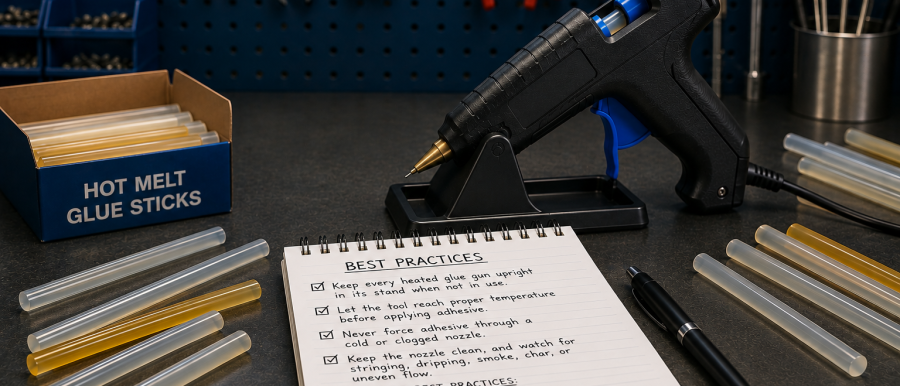
Daily best practices can prevent glue gun downtime before it starts. Keep every heated glue gun upright in its stand when not in use. Let the tool reach proper temperature before applying adhesive. Never force adhesive through a cold or clogged nozzle. Keep the nozzle clean, and watch for stringing, dripping, smoke, char, or uneven flow.
Operators should report glue gun problems early. A small change in bead shape, adhesive flow, or nozzle cleanliness can be an early sign of larger hot melt glue gun problems. Catching those signs early can reduce scrap, cleanup time, and unnecessary glue gun downtime.
Shutdown practices matter too. Place the tool in its stand, clean visible buildup safely, follow manual instructions, and allow heated areas to cool before handling. A hot melt glue gun should never be stored on its side while hot, because poor storage can create glue gun downtime later.
Maintenance and Compatibility
Routine maintenance should include nozzle inspection, buildup removal, applicator checks, hose checks, residue cleaning, worn-part replacement, and temperature verification. These steps support cleaner application, fewer glue gun problems, and less glue gun downtime.
The adhesive must work with the gun type, production speed, operation style, bead size, substrates, temperature range, and operator environment. Even the best adhesive can cause hot melt glue gun problems if the wrong glue sticks are used or if the application window does not match the process.
The Bottom Line
Industrial glue gun performance depends on the full application environment. When hot melt, equipment, temperature, nozzles, handling habits, and glue sticks all work together, production teams see cleaner bonds and fewer interruptions.
AJ Adhesives helps customers reduce glue gun downtime by looking beyond the adhesive alone. Through practical glue gun troubleshooting, adhesive selection support, and application guidance, AJ Adhesives helps teams identify the real cause of hot melt glue gun problems and improve glue gun troubleshooting habits.
 Ready to discuss what will be best for your line? Contact your AJ Adhesives representative today!
To speak with someone immediately, call: (314) 652-4583
For more information or questions, email us at: info@ajadhesives.com
Follow us on LinkedIn & Facebook for more tips, resources, and updates!