News
AJ Adhesives, Inc. – Holding North American Manufacturing Together.
Choosing the Right Adhesive Application Method for Packaging Equipment Compatibility
AJ Adhesives | Week #19
OEM/Equipment/System Compatibility: Choosing the Right Adhesive Application Method for Packaging Equipment Compatibility
May 13, 2026
Adhesive performance is not only determined by the adhesive itself. On packaging lines, the adhesive application methods play a major role in whether the adhesive bonds cleanly, runs efficiently, and works with the equipment already in place.
For OEMs, maintenance teams, operators, and purchasing departments, this matters because a good adhesive can still underperform if the dispensing method, nozzle style, pattern control, compression window, or substrate handling does not match the application.
The real question is not just, “Which adhesive should we use?”
It is, “Which adhesive application method fits the system?”
Why Adhesive Application Methods Matter
Packaging adhesive systems are designed to apply adhesives in specific patterns, amounts, and locations. Nordson notes that adhesive dispensing systems are used to apply adhesives, sealants, and coatings in multiple patterns across packaging, product assembly, and other industrial applications.
That means the method of application directly affects:
- Bond consistency
- Adhesive usage
- Equipment cleanliness
- Line speed compatibility
- Substrate coverage
- Maintenance frequency
We have previously touched on reducing adhesive use, making the same point from an efficiency standpoint: correct bead size, pattern, nozzle selection, cutoff, and timing help prevent excess adhesive, stringing, squeeze-out, and buildup.
Bead Application: Best for Targeted Bonds
Bead application is one of the most common methods for hot melt packaging adhesives. It places adhesive in a controlled line or dot pattern, usually through nozzles or applicator guns.
This method works well for:
- Case sealing
- Carton closing
- Tray forming
- Seams and flaps
- Targeted compression points
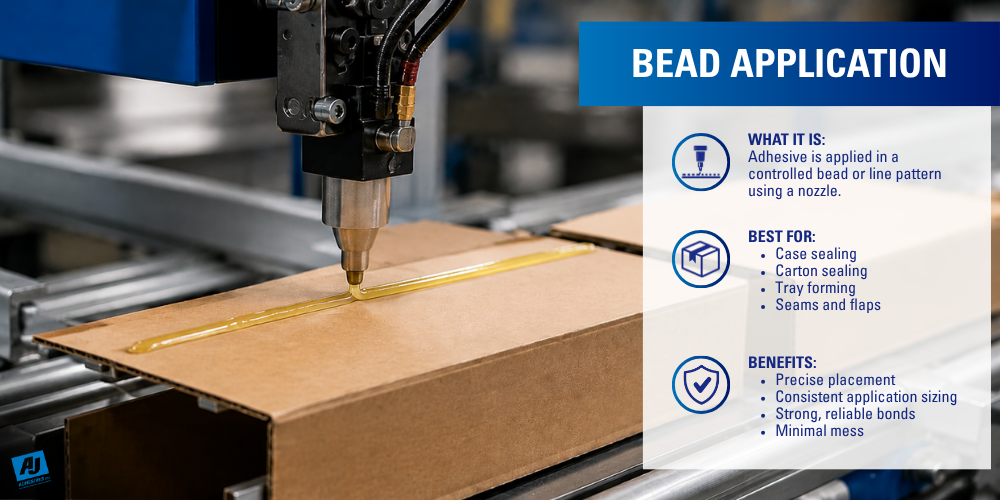
H.B. Fuller describes extrusion through nozzles in bead or line patterns as ideal when adhesive is required in a specific spot, especially in closure systems.
From an OEM and system compatibility standpoint, bead application depends heavily on nozzle alignment, cutoff timing, adhesive viscosity, and compression. If the bead lands too early, too late, or in the wrong position, bond failure may look like an adhesive issue when the real problem is application timing.
Spray and Swirl Application: Better Coverage, More System Sensitivity
Spray, spiral, and swirl patterns are often used when wider coverage is needed without applying a heavy bead. These methods can be useful for lightweight substrates, heat-sensitive materials, or applications where even distribution matters.
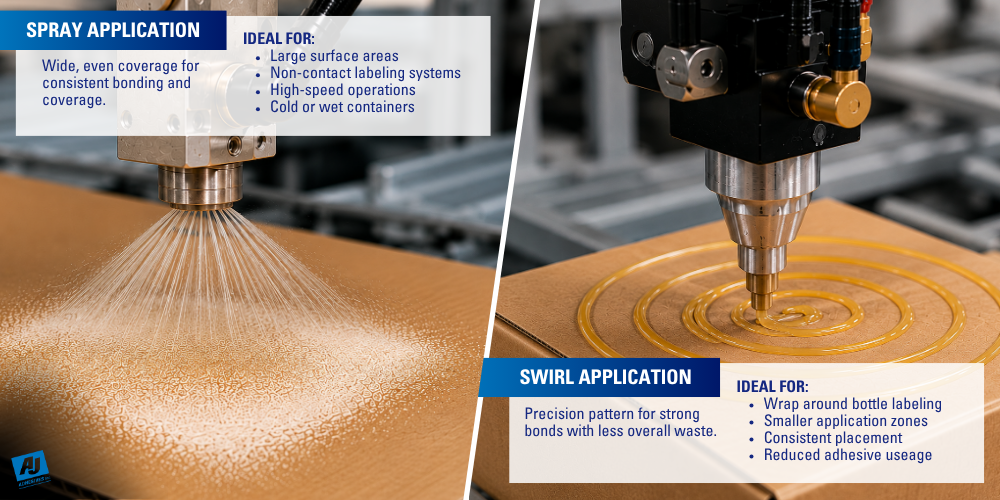
H.B. Fuller identifies spraying as useful for larger coverage areas, fast line speeds, and heat-sensitive substrates. Graco also describes swirl technology as a way to apply uniform circular loop patterns with clean edges, while allowing different bead widths and patterns for varied applications.
However, spray and swirl systems are more sensitive to setup conditions. Air pressure, nozzle condition, adhesive temperature, and pattern control all influence performance. If the OEM equipment is not designed for that style of application, switching from bead to spray may require more than a product change.
Roll Coating and Wheel Application: Consistency for Flat Surfaces
Roll coating and wheel application are common in labeling, laminating, and flat-surface bonding. These methods spread adhesive across a controlled surface area and can support clean, repeatable transfer when the adhesive viscosity, substrate, and machine speed are aligned.
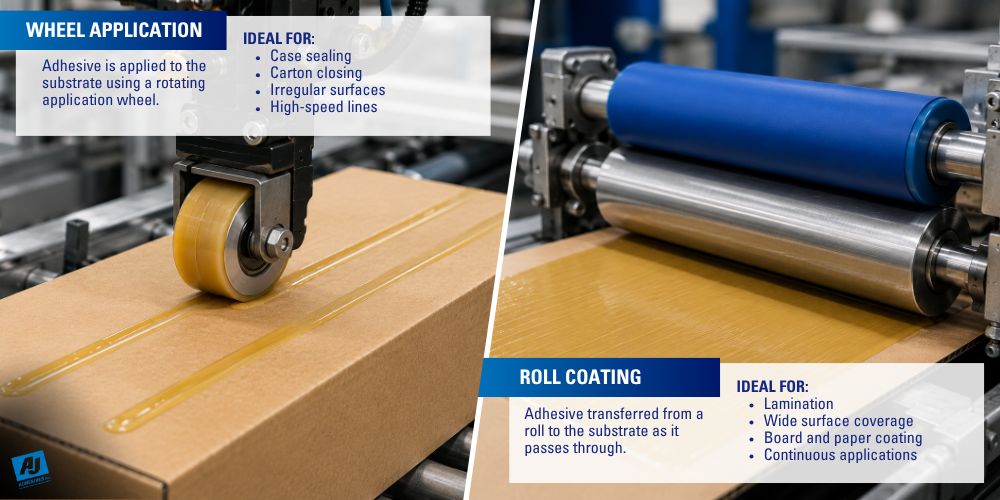
H.B. Fuller describes roll coating as a quick and even way to apply adhesive to flat substrates such as paper, wood, metal, or plastic.
For packaging teams, roll or wheel systems are often about transfer control. Too much adhesive can cause squeeze-out or messy buildup. Too little can create skips, lifting, or poor label placement. This is where adhesive selection must match pumpability, viscosity, open time, and the mechanical limits of the labeling equipment.
Slot Die Coating: Precision for Uniform Coverage
Slot die coating is often used where consistent adhesive thickness is critical, especially with pressure-sensitive adhesives, films, tapes, and web-based materials. Henkel describes hot melt slot coating as a process where a layer of adhesive is applied to the substrate before cooling and solidifying, often with pressure-sensitive adhesives on thin substrates.
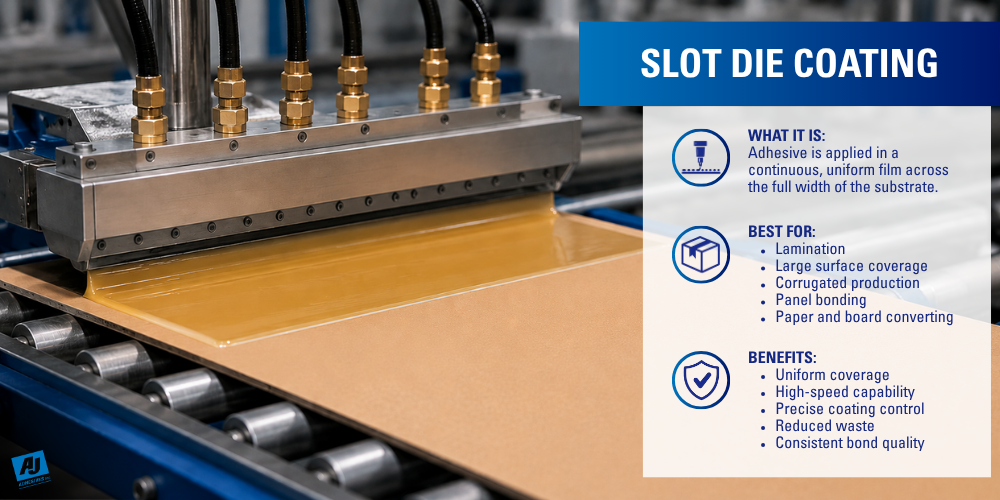
Nordson also notes that hot melt adhesive is pumped into the die and exits in contact with a moving web, with pressure needed to achieve proper wet-out due to melt flow characteristics and substrate surface energy.
This method can be highly precise, but it requires strong compatibility between adhesive rheology, web speed, coating gap, substrate, and equipment design.
The Compatibility Question: Adhesive, Equipment, or Both?
When packaging performance changes, teams often look first at the adhesive. But in many cases, the adhesive application methods reveal the real issue.
Before changing products, ask:
- Is the current applicator designed for bead, spray, roll, or coating use?
- Is the adhesive viscosity appropriate for the pump and nozzle?
- Is the pattern repeatable at actual line speed?
- Does the substrate need targeted placement or broad coverage?
- Is compression happening inside the adhesive’s open time?
- Are nozzles, wheels, or dies creating consistent transfer?
AJ Adhesives has covered this system-based thinking before: adhesive performance is shaped by equipment setup, substrates, line speed, and operating conditions—not chemistry alone.
Final Thoughts on Adhesive Application Methods
Adhesive application methods influence packaging performance because they determine how the adhesive reaches the substrate, how consistently it transfers, and whether the equipment can repeat that process at production speed.
Bead, spray, swirl, roll, wheel, and slot die systems each have strengths, but none work well in isolation. The best method depends on the adhesive formulation, OEM equipment design, substrate type, compression window, and performance goal.
At AJ Adhesives, we help manufacturers evaluate adhesives as part of the full packaging system—so the product, equipment, and application method work together instead of creating avoidable line issues.
 Ready to discuss what will be best for your line? Contact your AJ Adhesives representative today!
To speak with someone immediately, call: (314) 652-4583
For more information or questions, email us at: info@ajadhesives.com
Follow us on LinkedIn & Facebook for more tips, resources, and updates!