News
AJ Adhesives, Inc. – Holding North American Manufacturing Together.
Troubleshooting Guide: Hot Melt Adhesive Stringing
AJ Adhesives’ Blog: Tech Tips & Troubleshooting – Hot Melt Stringing in Packaging Applications
April 15, 2026
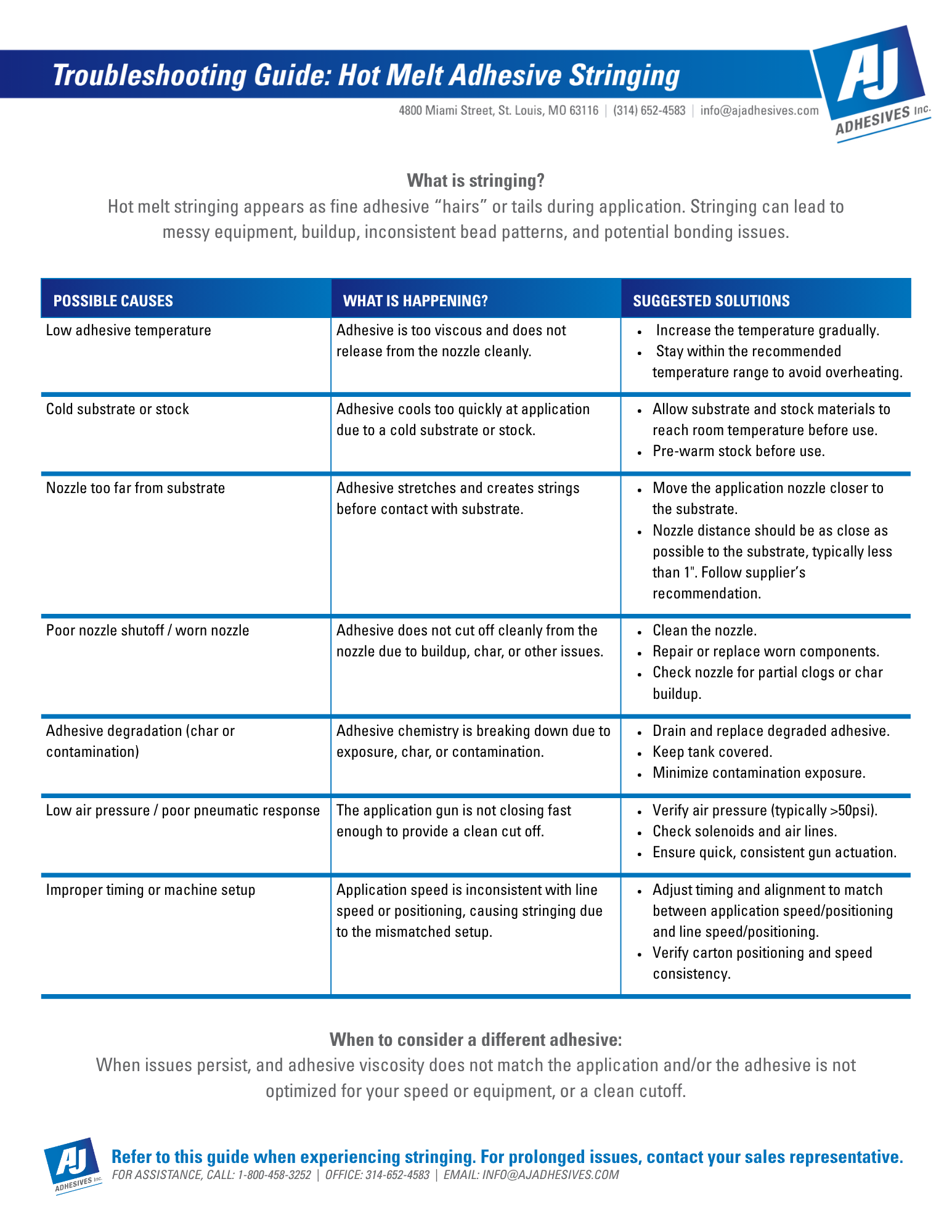
Hot melt stringing is one of the most common adhesive issues that packaging applications operators encounter on production lines. It can appear as fine adhesive hairs between the nozzle and the substrate, cobwebbing around the application area, or messy tails at the end of the bead. When stringing develops, it does more than make the line look messy. It can contribute to adhesive buildup on equipment, inconsistent application patterns, poor cutoff, and bond quality issues that gradually affect line performance. AJ Adhesives’ troubleshooting guide identifies stringing as a packaging problem commonly linked to nozzle position, temperature, substrate conditions, bead placement, and air pressure.
Download the AJ Adhesives Hot Melt Stringing Troubleshooting Guide!
What is Hot Melt Stringing?
In practical terms, hot melt stringing happens when the adhesive does not separate cleanly at the nozzle cutoff. Instead of forming a controlled bead and releasing cleanly onto the substrate, the adhesive stretches into thin strands. Stringing can also be referred to as angel hair or cobwebbing, which is a useful reminder that stringing can range from minor tails to widespread adhesive webs around the machine.
This matters because a clean cutoff is a big part of stable adhesive performance. When the bead does not release correctly, operators may start seeing:
- adhesive hairs around the nozzle or carton path
- buildup on nearby machine parts
- inconsistent bead placement
- contamination on flaps, guides, or compression areas
- more frequent cleaning and adjustments
Over time, those small symptoms can turn into larger productivity issues.
Common Causes of Hot Melt Stringing
Hot melt stringing is usually not caused by a single factor. It is often the result of application conditions drifting outside the adhesive’s best operating window.
Common Cause #1: Running Temperature Is Too Low
Low running temperature is one of the most widely cited causes of stringing. When low running temperature is a cause of stringing, we recommend raising the temperature carefully, while noting that excessively high temperatures can affect heat stability.
Why this happens: when the temperature is too low, the viscosity remains too high, and the adhesive may not release cleanly from the nozzle. When changing the temperature to attempt to fix stringing issues, we recommend raising the temperature slowly, without exceeding the recommended application range.
Common Cause #2: Stock or Substrate Temperature Is Too Low
Stringing is not only about the adhesive itself. Low substrate temperature is a common cause of stringing, and a solution can be pre-warming. Cold substrates can cool the adhesive too quickly near the point of application, interfering with bead formation and cutoff behavior. So, stringing can occur when the substrate temperature is too low, so allowing substrates to adjust to warm to ambient temperatures can prevent stringing.
Common Cause #3: Nozzle Is Too Far from the Substrate
Distance to substrate can be a major mechanical cause of stringing. The distance of the nozzle from the substrate being too large is a probable cause of stringing, so we recommend adjusting nozzle spacing if this is noticed by operators. The distance between the gun and the substrate should not exceed 1 inch because the farther the adhesive must travel, the greater the chance there is of stringing.
A more specific recommendation is to keep the applicator gun as close as possible to the substrate, ideally around 0.125″ to 0.25″, and preferably not over 0.75″.
Common Cause #4: Poor Nozzle Shutoff or a Worn/Plugged Nozzle
Just like distance, nozzle condition plays a direct role in clean cutoff. Poor shutoff of the nozzle, including worn or partially plugged nozzles, can be a cause of stringing. We recommend cleaning, repairing, or replacing the shutoff or nozzle. You should note that char can clog nozzles and interfere with proper cutoff as well.
Paying attention to nozzle condition is especially important on lines that have begun to show char, contamination, or inconsistent bead patterns. Once nozzle performance degrades, stringing often follows.
Common Cause #5: Adhesive Degradation and Char
Stringing may also be a symptom of degraded adhesive. Adhesive degradation can be a cause of stringing. When this is identified, we recommend draining the adhesive and replacing it with fresh material. Oxidation over time can create char and viscosity instability within adhesives.
This can be a singular instance of, or culmination of, oxidation, contamination, and char buildup with unstable hot melt behavior. Our recommendation is to keep tanks covered and minimize airborne contamination to reduce charring and gelling problems.
Common Cause #6: Air Pressure and Solenoid Issues
Stringing is not always a temperature issue. It can also be mechanical or pneumatic. Low air pressure to the solenoid can be a cause of stringing, and when it is identified, we recommend ensuring incoming air pressure is greater than 50 psi while inspecting for muffler buildup.
Overall, poor exhaust, worn solenoids, low-rated solenoids, or slow closing on pneumatic guns, which can all contribute to stringing because the module does not close with enough speed and accuracy.
Additionally, when solenoids are too far from the guns, a delay in air delivery can cause misfiring and poor cutoff. A general recommendation is to reposition solenoids closer to the gun, around 40–60 mm away.
Common Cause #7: Pressure, Timing, and Line Setup
Poor timing or misalignment of the carton flap to the applicator roll can be another source of stringing, and a solution can be machine adjustment.
Another cause can be the passage of the blank under the guns being too fast, which can cool the nozzle tip and contribute to stringing.
Inadequate hydraulic pressure can contribute to poor pattern formation and stringing, while higher pressure can improve exit velocity and cleaner cutoff in the correct operating range.
How Operators Can Reduce Hot Melt Stringing
The most effective way to reduce stringing is to troubleshoot systematically instead of changing multiple settings at once.
#1: Start with Temperature Verification
First, confirm actual operating temperatures, not just controller setpoints. We advise checking that each zone’s set point is calibrated to indicate actual temperature. If the actual temperature is low, increase it gradually within the adhesive’s recommended application range.
#2: Check Nozzle Distance and Placement
Then verify that the nozzle is positioned close enough to the substrate. If the nozzle is too far away, the adhesive has more opportunity to stretch before it is cut off.
#3: Inspect Nozzles for Wear, Plugging, and Char
A partially plugged or worn nozzle may still run, but it will not deliver a clean, repeatable bead. Cleaning or replacing the nozzle is often one of the fastest corrective actions.
#4: Review Air Pressure and Solenoid Performance
If temperature and nozzle spacing look correct, check the air side of the system. Low incoming air pressure, delayed solenoid response, or poor exhaust can slow gun closing and create tails or strings.
#5: Evaluate Adhesive Condition
If the adhesive has been at temperature too long, shows char, or is running inconsistently, fresh adhesive may be needed. Degradation and oxidation are directly connected with viscosity instability and stringing.
#6: Confirm the Adhesive Is Right for the Application
Formula can matter too. Lower-viscosity products often produce cleaner cutoff, while incompatibility at application temperature and rheology can also influence stringing tendency. In other words, sometimes the line setup is acceptable, but the adhesive is not the best fit for the equipment, nozzle style, or operating speed.
Why Stringing Should Be Addressed Early
Stringing rarely stays isolated. What begins as a minor visual issue can lead to buildup on nozzles, rails, flaps, and compression areas. That increases cleanup time, raises the risk of poor bead placement, and can eventually affect bond consistency. Many adhesive problems are connected rather than isolated, so addressing issues early can save you time and costly rework.
That is why it is worth treating stringing as an early warning sign, not just a cosmetic nuisance.
Final Thoughts
Hot melt stringing in packaging applications is usually a signal of another issue. It often points to low temperature, cold stock, poor nozzle spacing, worn shutoff components, pneumatic delays, degraded adhesive, or an adhesive/equipment mismatch. The good news is that these issues are often correctable with practical adjustments before they turn into larger downtime or bonding problems.
At AJ Adhesives, troubleshooting is not only about changing products. It is about helping operators, maintenance teams, and production managers identify what changed on the line and correct the root cause. When stringing starts to appear, a structured review of temperature, nozzle condition, air delivery, and adhesive selection can usually get the line back to cleaner, more stable performance. If hot melt stringing is creating buildup, inconsistent application, or repeated line interruptions, AJ Adhesives can help evaluate your process and recommend adjustments or adhesive options that better fit your equipment and packaging conditions.
 Ready to find the solution for your line? Contact your AJ Adhesives representative today!
To speak with someone immediately, call: (314) 652-4583
For more information or questions, email us at: info@ajadhesives.com
Follow us on LinkedIn & Facebook for more tips, resources, and updates!