News
AJ Adhesives, Inc. – Holding North American Manufacturing Together.
Adhesive Innovations in End-of-Line Packaging
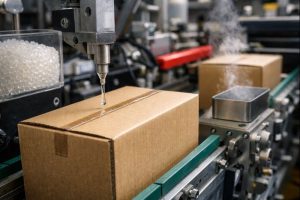 End-of-line packaging adhesives have quietly changed more in the last few years than most operations realize. While the fundamentals of case and carton sealing haven’t shifted, the chemistry behind modern EVAs, metallocenes, and low-temperature hot melts has—and those changes are showing up in cleaner runs, tighter process windows, and fewer compromises between speed, strength, and maintenance.
In 2026, innovation at the end of the line is less about chasing new materials and more about refining performance under real-world conditions: recycled corrugated, higher speeds, shorter compression times, and longer production runs without shutdowns.
Water-White EVA Adhesives: More Than Just Appearance
Water-white EVA formulations are no longer just “clearer versions” of traditional EVAs. Newer chemistries are being engineered for improved stability and more predictable set behavior, particularly on lighter-weight and printed corrugate.
What’s different from older EVAs:
- Tighter viscosity control across operating ranges
- Cleaner bead definition at higher line speeds
- Reduced stringing and less adhesive buildup around nozzles
For operations still running EVAs at the end of the line, these formulations offer a way to maintain familiar processing characteristics while improving consistency and reducing cleanup—especially on retail-ready and visually sensitive packaging.
Water-white EVAs continue to make sense where appearance, predictable compression windows, and straightforward application are priorities. The performance gap between them and higher-end chemistries has narrowed significantly.
Featured Water-White EVA:
AJ 1526 – New generation low odor, water clear hot melt with excellent adhesion and heat stability for reliable performance. Typically used for case sealing, carton sealing, and tray forming—bonding most typical paper surfaces such as corrugated, SBS, SUS, and fiberboard.
- Application Temperature: 325-365°F, suggested at 350°F
- Viscosity: Average at 1,000cPs
- Fast Set Speed, Short Open Time, 2-year Shelf Life
High-Performance Metallocenes: Built for Variability and Long Runs
Metallocene hot melts have become the workhorse adhesive for many end-of-line packaging applications—not because they are new, but because their performance under less-than-ideal conditions keeps improving.
Recent formulation advancements focus on:
- Increased thermal stability for reduced charring
- Improved bonds on high-recycled-content corrugated
- Strong fiber tear at reduced application weights
For operators, this shows up as:
- More forgiving bonds when board quality fluctuates
- Fewer nozzle issues due to reduced charring
- The ability to dial back adhesive usage without sacrificing seal integrity
Metallocenes are increasingly selected not just for speed, but for process stability—especially in operations running mixed SKUs, variable corrugated suppliers, or multiple shifts without frequent cleanouts.
Featured High-Performance Metallocene:
AJ 1910 – Premium light colored hot melt with excellent heat stability and clean machining properties with great milage. Typically used for case sealing, carton sealing, and tray forming with good high and low temperature bond performance.
- Application Temperature: 340-360°F
- Viscosity: 785cPs
- Fast Set Speed, 2-year Shelf Life
Low-Temperature Hot Melts: Process Control, Not Just Energy Reduction
Low-temperature HMAs have moved well beyond being positioned as “energy-saving alternatives.” In practice, their biggest impact is often process consistency and equipment health.
Modern low-temp formulations are engineered to:
- Set quickly despite reduced application temperatures
- Maintain bond strength across a wider temperature window
- Minimize adhesive degradation inside melters and hoses
Running at lower temperatures reduces char formation, stabilizes viscosity over time, and decreases stress on system components. For many lines, this translates to less day-to-day adjustment and fewer maintenance-driven interruptions—without sacrificing throughput.
Low-temperature adhesives are now being used not only on slower or secondary lines, but increasingly on high-speed case sealers where consistent performance matters more than peak temperature capability.
Featured Low-Temperature Hot Melt:
AJ 4020 – Premium low-temperature hot melt utilized on high-speed packaging lines with a low odor and fast set time. Bonds well with most substrates associated with case and carton sealing applications. Advantages include reduced maintenance and parts replacement, increased safety, and reduced consumption leading to saved energy costs.
- Application Temperature: 225-275°F, suggested at 250°F
- Viscosity: 1,050cPs
- Fast Set Speed, Short Open Time, 2-year Shelf Life
Selecting the Right End-of-Line Packaging Adhesive: Application First, Chemistry Second
With today’s adhesive options, the challenge is no longer availability—it’s alignment with your production process.
Water-white EVAs, metallocenes, and low-temperature HMAs each perform exceptionally well when matched correctly. The deciding factors tend to be:
- Line speed and available compression time
- Corrugated grade, coatings, and recycled content
- Product end-use exposure, including thermal extremes, vibration, and handling conditions
- Equipment configuration and maintenance strategy
Issues arise when an adhesive is chosen based on category alone, rather than how it behaves on a specific line. The most successful transitions happen when formulation behavior is evaluated alongside equipment setup and actual production conditions. This is true for both shifts from EVA to metallocene and moves to lower-temperature operations.
At AJ Adhesives, end-of-line packaging adhesives are approached as part of the packaging system, not a standalone input. That means working through application details, understanding where variability is coming from, and selecting formulations that support stable operation over time—not just initial bond strength.
The goal isn’t to run the newest chemistry available. It’s to run an adhesive that allows your line to operate consistently, quietly, and without constant adjustment.
End-of-Line Packaging Adhesive Features Summary:
- AJ 1526 – Water-white EVA for case sealing, carton sealing, and tray forming on a variety of substrates with excellent heat stability and a fast set time.
- AJ 1910 – High-performance metallocene for case sealing, carton sealing, and tray forming with clean machining properties.
- AJ 4020 – Low temperature hot melt for case and carton sealing with reduced maintenance and parts replacements, and reduced consumption, leading to energy cost savings.
Learn more about AJ Adhesives products
Want to discuss what end-of-line packaging adhesive is right for your production line? Contact your AJ representative today! – Contact us
To speak with someone immediately, call: (314) 652-4583
For more information or questions, email us at: info@ajadhesives.com
Follow us on LinkedIn & Facebook for more tips, resources, and updates!