News
AJ Adhesives, Inc. – Holding North American Manufacturing Together.
Packaging EPR Laws: 2026 State Requirements & Updates
AJ Adhesives | Week #26
Packaging EPR Laws: 2026 State Requirements & Updates
July 1, 2026
For decades, the financial and operational responsibility for collecting, sorting, and managing packaging waste in the United States has largely rested with local governments, municipal recycling programs, taxpayers, and ratepayers. Packaging EPR laws are intended to shift a larger share of those end-of-life costs and responsibilities to the companies that place covered packaging into the market. [1]
The current policy movement reflects concern that traditional recycling systems have not consistently generated enough funding, market coordination, or design incentives to manage growing packaging volumes. State packaging EPR laws and programs therefore combine producer funding with requirements for reporting, material reduction, recyclability, reuse, collection, and recycling. [1, 3]
Maine became the first U.S. state to enact comprehensive packaging EPR laws. By late June 2026, seven states had enacted comprehensive packaging EPR laws: California, Colorado, Maine, Maryland, Minnesota, Oregon, and Washington. [2] The movement remains state-led rather than governed by one national EPR statute. This creates a patchwork of different definitions, covered materials, exemptions, reporting systems, implementation schedules, fee structures, recycling targets, and sales restrictions. [1, 2, 3] California is especially influential because many producers do not manufacture separate packaging exclusively for California. When a large state imposes design or compliance standards, companies may change national packaging portfolios rather than maintain separate state-specific SKUs. [1]
What is Extended Producer Responsibility (EPR)?
Extended producer responsibility, or EPR, is a policy approach that assigns producers primary financial and/or operational responsibility for managing products and packaging after their useful life. In packaging programs, the responsible producer may be a manufacturer, brand owner, importer, license holder, or another entity that first places the covered product into a state market. [1, 19]
Packaging EPR laws and programs generally require covered producers to join or form a producer responsibility organization (PRO), report the types and quantities of packaging supplied, pay fees, and support a statewide system for collection, recycling, reuse, composting, education, infrastructure, or market development. [1, 2, 3]
The Circular Action Alliance (CAA) is the approved or designated PRO in California, Colorado, Maryland, Minnesota, Oregon, and Washington. Maine’s stewardship organization had not yet been selected as of late June 2026, although the state issued an RFP on June 15, 2026. [2, 3, 21]
Common packaging EPR laws and policy goals include:
- Moving end-of-life costs away from municipalities and taxpayers and toward producers.
- Encouraging packaging reduction, reuse, refill, recyclability, and compostability.
- Creating stable funding for collection, sorting, processing, education, and recycling infrastructure.
- Using fees or “eco-modulation” to reward packaging designs that are easier to recover and penalize designs that create higher system costs.
- Improving data about the quantity, type, weight, composition, and recyclability of packaging supplied into each state.
Packaging EPR laws are broader than a recycled-content mandate. Recycled-content laws require certain products to contain specified percentages of postconsumer material. A comprehensive packaging EPR law creates a producer-funded management system and usually includes registration, reporting, planning, and program-financing obligations. [3, 6, 7]
Overview of Current State Packaging EPR Laws in the United States
Below is the current overview of the seven states that have passed pakaging EPR laws.
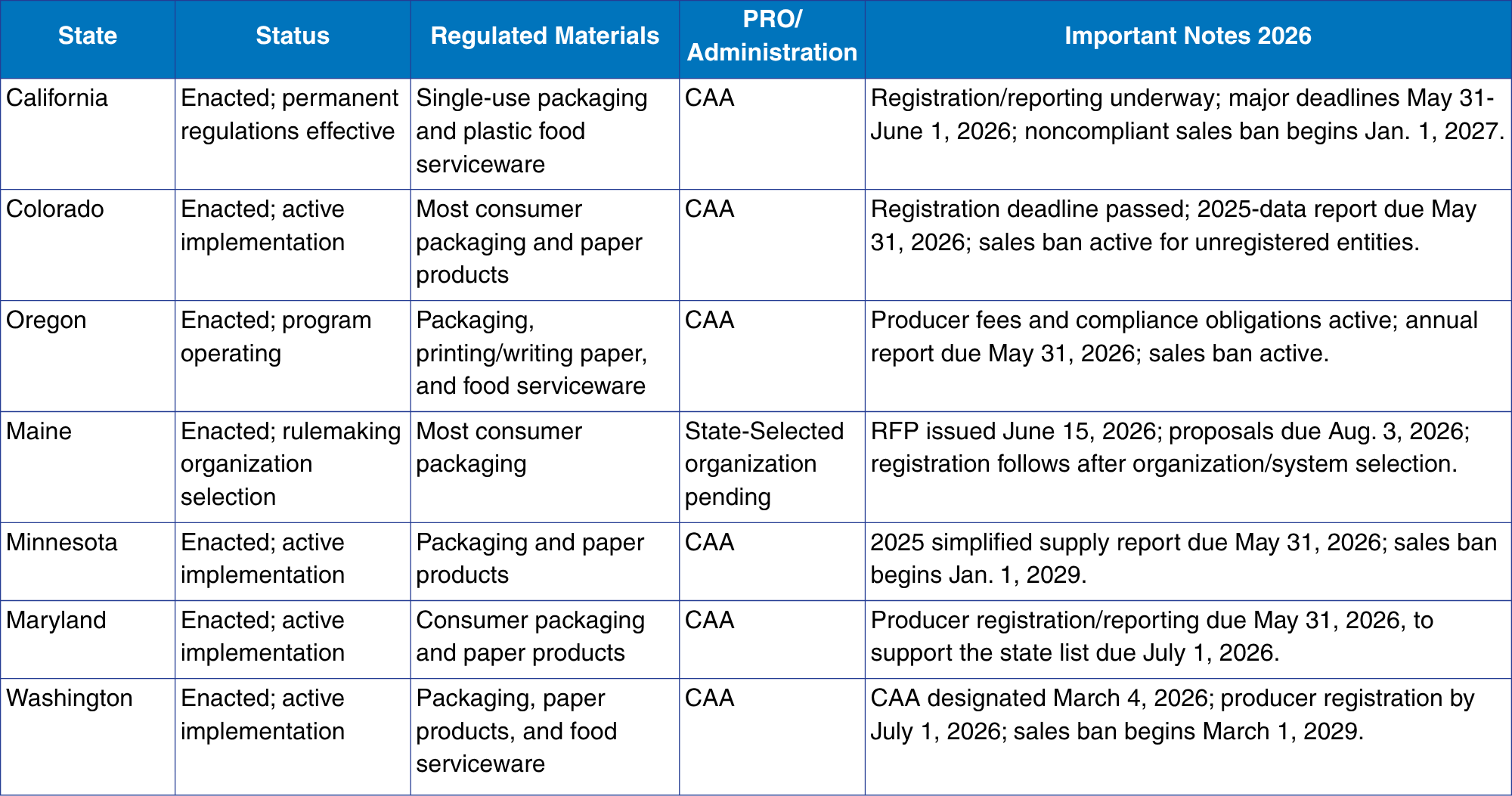
Beyond the seven enacted states, several states were studying EPR, debating legislation, or operating related product-stewardship and recycled-content programs. The most active states identified in the research were New York, New Jersey, Hawaii, Rhode Island, Illinois, Massachusetts, Michigan, Tennessee, and Missouri. [5, 6, 8, 9, 10, 11, 15, 16, 17]
Not every active proposal advanced in 2026. New York’s S.1464A/A.1749A failed to pass before adjournment, Tennessee’s Waste to Jobs Act was sidelined, and Missouri HB 3504 remained in an early committee stage. [17, 22, 23]
California’s law was also challenged in federal court by 17 states in June 2026. The lawsuit did not automatically suspend SB 54, so the law and reporting obligations remained active unless a court issued an injunction or later overturned part of the program. [20]
Important EPR Legislation Dates
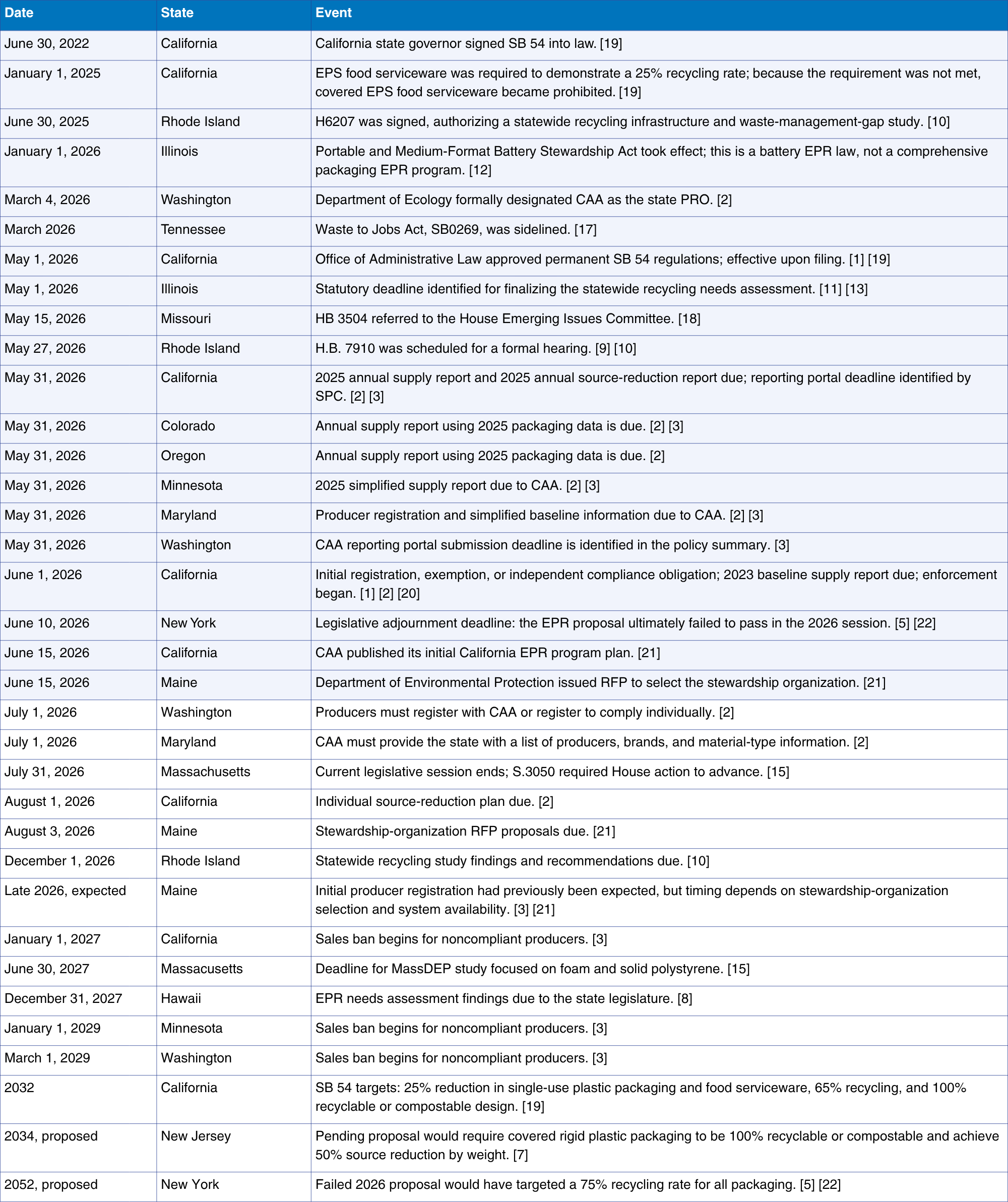
The following timeline consolidates some major dates for packaging EPR laws and legislation. Dates are organized chronologically and include enacted-law obligations, rulemaking milestones, study deadlines, and pending-legislation events.
State-By-State Breakdown of Current Packaging EPR Laws
California
- Status: SB 54, the Plastic Pollution Prevention and Packaging Producer Responsibility Act, is enacted and its permanent regulations became effective May 1, 2026. Enforcement and initial registration obligations began June 1, 2026. [1, 19]
- Covered materials: The program covers packaging and single-use plastic food serviceware across sectors of the economy. [19]
- Administrator: CAA is the PRO. CalRecycle launched PEPRS as the central state system for registration, data submission, and compliance tracking. [1, 3]
- Producer responsibility: The responsible producer can include brand owners, importers, and license holders, generally focusing on the first entity placing packaged goods into the California market. [1]
- Targets: By 2032, California requires a 25% reduction in single-use plastic packaging and food serviceware, a 65% recycling rate, and 100% recyclable or compostable design. [19]
- Fees and design implications: CAA’s June 2026 plan indicated that future costs may reflect packaging weight, category, material composition, component count, reuse/refill obligations, and plastic-pollution mitigation charges. Published fee examples were still illustrative. [21]
- Legal challenge: Seventeen states sued California in June 2026, alleging interstate-commerce burdens. The suit did not automatically suspend the law. [20]
Colorado
- Status: Comprehensive packaging EPR laws enacted and in active implementation. [2, 3]
- Covered materials: Most consumer packaging and paper products. [3]
- Administrator: CAA. [3]
- Key requirements: Registration deadline had passed, annual supply reporting using 2025 packaging data was due May 31, 2026, and a sales ban was active for unregistered entities. [2, 3]
Oregon
- Status: The Plastic Pollution and Recycling Modernization Act is in effect, with producer fees and compliance obligations underway. [2, 4]
- Covered materials: Packaging, printing and writing paper, and food serviceware. [3]
- Administrator: CAA. [3]
- Program approach: The law modernizes local recycling programs while leveraging producer resources. Producer fees are based on supplied-material data, and an active sales ban applies. [3, 4]
Maine
- Status: Maine enacted the first comprehensive U.S. packaging EPR laws, but implementation remained in the stewardship-organization selection stage in June 2026. [2, 3]
- Covered materials: Most types of consumer packaging. [3]
- Administrator: A state-selected stewardship organization; selection was pending. [3, 21]
- June 2026 update: Maine DEP issued an RFP on June 15, 2026, with proposals due August 3, 2026. Producers cannot register until the organization is selected and a registration mechanism is available. Producers are expected to receive at least 90 days to register after the system opens. [21]
Minnesota
- Status: The Packaging Waste and Cost Reduction Act is enacted and implementation is underway. [2]
- Covered materials: Packaging and paper products. [3]
- Administrator: CAA, confirmed by the Minnesota Pollution Control Agency. [2, 3]
- Key requirements: Producers selling covered materials into Minnesota were required to submit 2025 supply information by May 31, 2026. The noncompliant-producer sales ban begins January 1, 2029. [2, 3]
Maryland
- Status: Comprehensive packaging EPR laws enacted; producer identification and baseline implementation were underway in 2026. [2, 3]
- Covered materials: Consumer packaging and paper products. [3]
- Administrator: CAA. [3]
- Key requirements: Producers were directed to register and submit baseline information by May 31, 2026 so CAA could provide the Maryland Department of the Environment a producer, brand, and material list by July 1, 2026. [2]
Washington
- Status: The Recycling Reform Act is enacted and implementation is underway. [2]
- Covered materials: Covered packaging, paper products, and food serviceware. [2, 3]
- Administrator: Washington Department of Ecology designated CAA on March 4, 2026. [2]
- Key requirements: Covered producers must register with CAA or register individually by July 1, 2026. The noncompliant-producer sales ban begins March 1, 2029. [2, 3]
New York
- Status: No comprehensive packaging EPR laws were enacted in the 2026 session. S.1464A/A.1749A failed to advance before adjournment. [22]
- Proposal: The proposal would have required qualifying producers to fund postconsumer packaging management, reduce packaging 10% within three years and 30% within 12 years, restrict certain toxic materials including PFAS, and target a 75% recycling rate by 2052. [5]
- Context: Supporters cited an estimated $788 million in annual state recycling spending, projected $1.3 billion in ten-year savings, and 73% voter support in a 2025 Siena poll. [5]
- Outlook: The bill may return in a later session, but it is not an enacted program as of June 2026. [22]
New Jersey
- Current law: New Jersey’s 2022 Recycled Content Law establishes postconsumer recycled-content requirements for specified plastic, glass, paper, and bag products and prohibits polystyrene loose-fill packaging. [6]
- EPR status: A comprehensive packaging EPR system remained pending. [7]
- Proposed requirements: Pending S673/S670 concepts included 50% source reduction for rigid plastics, 100% recyclable or compostable packaging by 2034, stronger recycled-content and recycling-rate requirements for paper, and integration of glass into a PRO-funded collection system. [7]
Hawaii
- Status: Hawaii had not enacted comprehensive packaging EPR laws, but it enacted an EPR needs-assessment law in 2025. [8]
- Study: The Department of Health began assessment work in July 2025, with findings due December 31, 2027. [8]
- Related activity: Four nonbinding resolutions introduced in March 2026 asked the state to study recyclable, biodegradable, and compostable product labeling. [8]
Rhode Island
- Status: Rhode Island was studying system readiness while considering direct EPR legislation. [9, 10]
- Study law: H6207, signed June 30, 2025, directed a third-party statewide recycling and waste-management-gap analysis, with recommendations due December 1, 2026. [10]
- Proposals: H.B. 7910 and S.B. 2656 would require producers of packaging and paper products to fund and manage recycling, composting, and reuse. The bills were held amid concerns about infrastructure readiness and distributor costs; H.B. 7910 had a May 27, 2026 hearing and S.B. 2656 remained under committee review. [9, 10]
Illinois
- Packaging status: Illinois had not yet enacted comprehensive packaging EPR laws. SB 1555, enacted in 2023, created the Statewide Recycling Needs Assessment Advisory Council and required a recycling needs assessment. [11, 13]
- Assessment: The assessment evaluates recycling, composting, reuse gaps, and costs and was described as a prerequisite for possible future producer-funded packaging policy. [13]
- Pending bill: HB 4064, the Extended Producer Responsibility and Recycling Refund Act, remained pending in the House Rules Committee and sought to move packaging-waste costs from taxpayers to producers. [14]
- Other EPR: Illinois’ battery stewardship law took effect January 1, 2026, requiring covered battery producers to fund a statewide recycling system. [12]
Massachusetts
- Status: Massachusetts had not enacted comprehensive packaging EPR laws by June 2026. [15]
- Legislation: The Senate passed S.3050, an environmental bill related to the Mass Ready Act, but House approval was still required before the July 31, 2026 session end. [15]
- Prior study: A commission launched by a 2024 climate and energy law issued its EPR recommendations in January 2026. It recommended EPR for batteries, paint, mattresses, and electronics; only paint was included in S.3050. [15]
- Packaging-related study: Approved amendments called for a MassDEP study of foam and solid polystyrene by June 30, 2027. [15]
Michigan
- Status: Michigan had no enacted comprehensive packaging EPR laws. [16]
- Prior proposal: House Bill 5902, which would have shifted packaging-waste costs to producers while excluding deposit containers, did not pass. [16]
- Existing stewardship: Michigan maintains an electronics takeback law and a $0.10 beverage-container deposit system. [16]
- Outlook: Advocates, including the Circular Michigan coalition, continued to push for broader producer-responsibility policy amid regional momentum. [16]
Tennessee
- Status: The Waste to Jobs Act, SB0269, was sidelined in March 2026 and was not enacted. [17]
- Proposal: The bill was presented as a business-friendly EPR model, with small-business and small-county exemptions. Larger counties and major brands would still participate, and producers would join a PRO that reimbursed local governments for recycling services and infrastructure. [17]
- Outlook: Sponsors and coalitions planned to return in future sessions. [17]
Missouri
- Status: Missouri HB 3504, the proposed Producer Responsibility Program for Statewide Recycling Act, remained an early-stage proposal and did not meaningfully advance in 2026. [18, 23]
- Proposal: The bill would require producers of packaging and paper products to join or form a nonprofit PRO to fund and manage a statewide recycling system. [9]
- Latest action: The bill was referred to the House Emerging Issues Committee on May 15, 2026. [18]
- Existing stewardship: Missouri already has an electronics producer-responsibility law requiring computer manufacturers to operate state-approved recovery plans. [9]

Click here to contact your AJ Adhesives representative to learn more about what you can do to prepare for your state’s packaging EPR laws!
Call: (314) 652-4583 | Email: info@ajadhesives.com
Follow us on LinkedIn for more tips, resources, and updates!
Sources
- California Senate Bill 54: Ushering in a New Era of Packaging Responsibility (May 27, 2026; updated May 28, 2026 – Christopher Smith, Partner, Saul Ewing LLP; Recycling Today)
- Environment & Energy Insights: May 2026 (May 27, 2026 – Matthew J. Connolly, Alexander R. Franzosa, Michelle Kenyon, and Matthew H. Snell; Nutter McClennen & Fish LLP; JD Supra)
- Policy and EPR (Sustainable Packaging Coalition)
- Modernizing Oregon’s Recycling System (Oregon Department of Environmental Quality)
- New York Packaging EPR Bill Faces June 10 Deadline (May 26, 2026 – Stefanie Valentic; Resource Recycling)
- Recycled Content Law (New Jersey Department of Environmental Protection)
- New Jersey Senate Bill 673 Text (New Jersey Legislature via LegiScan)
- Packaging Policy News (May 21, 2026 – Lucy Pierce; Sustainable Packaging Coalition)
- Missouri, Rhode Island Weigh EPR Laws Targeting Packaging (April 20, 2026 – Tim O’Connor; Foodservice Equipment Distributors Association)
- Rhode Island Study Bill on Recycling, EPR and Bottle Bill Goes to Governor (June 26, 2025 – Megan Quinn; Waste Dive)
- EPR Packaging and Recycled Content Laws (February 28, 2025 – Beveridge & Diamond; JD Supra)
- Illinois Expands Battery Recycling as Lithium-Ion Fire Concerns Mount (May 27, 2026 – Keith Loria; Resource Recycling)
- Statewide Recycling Needs Assessment Advisory Council (Illinois Environmental Protection Agency)
- Illinois House Bill 4064 (2025-2026 legislative session – Illinois General Assembly via LegiScan)
- Massachusetts Senate Passes Environmental Bill with Paint EPR and Plastic Provisions (April 16, 2026 – Cole Rosengren; Waste Dive)
- Michigan Democrats Introduce Packaging EPR Bill (August 27, 2024 – Marissa Heffernan; Resource Recycling)
- Tennessee Extended Producer Responsibility Packaging Bill Sidelined (February 10, 2026 – Megan Quinn; Waste Dive)
- Missouri HB 3504 Bill Tracking Page (Last action May 15, 2026 – BillTrack50)
- Plastic Pollution Prevention and Packaging Producer Responsibility Act (Updated through May 2026 – CalRecycle, California Department of Resources Recycling and Recovery)
- U.S. States Sue California Over Landmark Plastics Packaging Law (June 23, 2026 – Reuters)
- Packaging Policy News (June 22, 2026 – Sustainable Packaging Coalition)
- New York Packaging EPR Bill Fails Again (June 2026 – Packaging Dive)
- Missouri HB 3504 Official Bill Page (2026 legislative session – Missouri House of Representatives)