Recyclable Packaging Adhesives: How Adhesive Choice Affects Recycling
Published
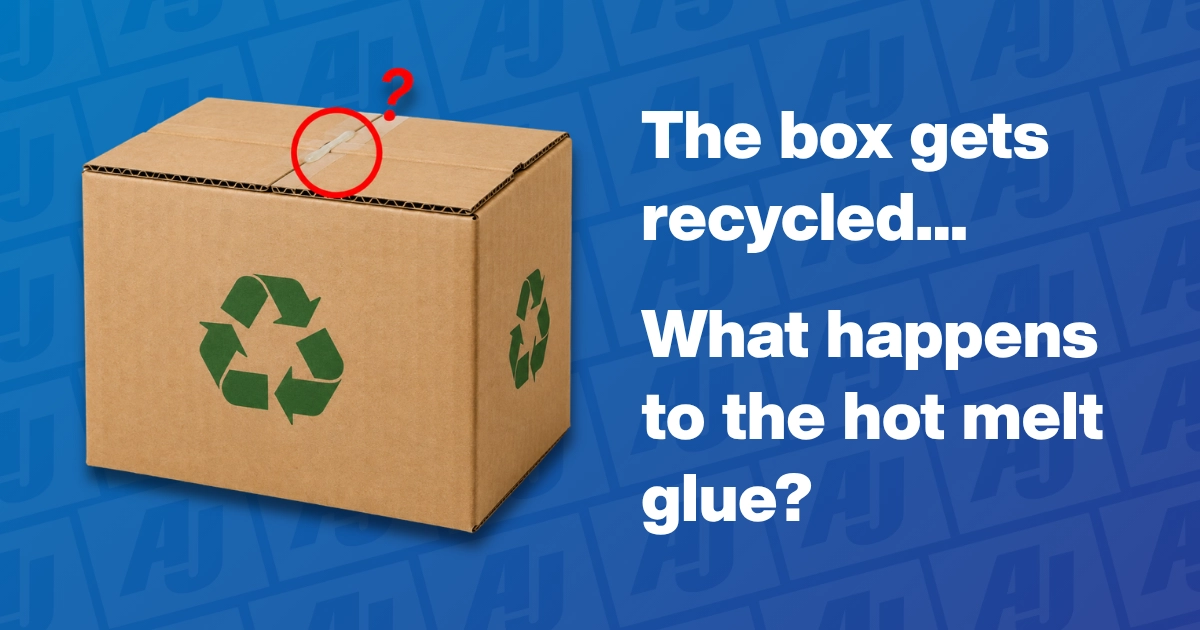
Recyclable packaging adhesives let the main package material recycle cleanly. On corrugated and paperboard, the adhesive should come out or break up in the pulper without leaving sticky specks. On PET bottles, the label adhesive should let go in the recycler's wash. To check your adhesive, start with your Technical Data Sheet (TDS) provided by your distributor or manufacturer.
Why Adhesive Choice Affects Packaging Recycling
Adhesives are a small part of a package, but recyclers have to deal with every part. H.B. Fuller notes that adhesives typically make up less than 5% of a package's total weight. Even so, they can decide how well the fibers recycle. An adhesive that doesn't fit the process can lower fiber yield and value.
The stakes are high for boxes. The American Forest & Paper Association (AF&PA) reports that 70% to 75% of cardboard available for recovery was recycled in the U.S. in 2025. That was more than 33 million tons. Nearly half of all recycled paper in 2025 went into containerboard, the material used to make new boxes. So, the glue on today's case can end up in the fiber for tomorrow's boxes.
How Adhesives Behave in Corrugated and Paperboard Recycling
Paper mills recycle by mixing old paper and boxes with water into pulp. Then they screen out anything that isn't fiber. Any adhesive in the load must either come out or work with that process. How it behaves depends on its chemistry, as H.B. Fuller explains. For more on these chemistries, see our hot melt vs. water-based adhesive selection guide.
- Hot melt adhesives: Hot melts stay hard and keep their shape in the pulper. They split from the fiber and either float or get caught in screens. They are a common choice for case and carton sealing.
- Water-based adhesives: These generally dissolve or disperse in water. They may break up in the pulper or come out later in de-inking. They are common in corrugating, laminating, and box assembly.
- Pressure-sensitive labels on boxes: Bostik explains that for a repulpable label, the adhesive, inks, and face stock must all be able to repulp. This matters when labels stay on cases that go to recycling.
What Stickies Are and Why Paper Mills Watch for Them
Stickies are small, tacky bits that slip through recycling. They can come from paper binders and some types of adhesive. H.B. Fuller explains that stickies can build up on paper machines and end up in the new paper. In the worst case, they cause defects in paper reels, process problems, and higher upkeep costs at the mill. So, when you aren't sure how an adhesive and paper pair will behave, testing is the way to find out.
What the FBA Voluntary Standard Covers
The Fibre Box Association (FBA) and AF&PA publish a voluntary standard for repulping and recycling coated or treated corrugated board. It was last revised March 31, 2025. It tests whether treated board can be repulped and recycled with common mill equipment. To pass, test sheets made with the treated board can show no more than 15 stickies counts, or no more than 30% above the untreated control.
Know what this standard does not cover. It was built for coatings and treatments, such as the moisture-resistant boxes used to ship produce, meat, and seafood. It is not a test program for case sealing or label adhesives. The standard notes that the normal joint adhesive on a box doesn't need to be reported. Mills routinely accept it in the old corrugated container (OCC) stream. However, switching to a special corrugating adhesive with extra water resistance means the treated board must be recertified.
| Package type | What recycling needs from the adhesive | What to ask your supplier |
|---|---|---|
| Corrugated cases and cartons | Comes out in screening or works with pulping, with few stickies | Any repulping test data for your board and glue amount |
| Coated or treated corrugated | The treated board passes FBA repulping and recycling tests | Whether a special corrugating adhesive is part of the certified treatment |
| Labels on corrugated | Adhesive, inks, and face stock all repulp | Whether the full label is designed to repulp |
| Labels on PET bottles | Adhesive lets go in the hot caustic wash | APR recognition or test results for the full label |
How Label Adhesives Affect PET Bottle Recycling
PET recycling works differently from paper. Recyclers grind bottles into flake and wash the flake in a hot caustic bath. Then they split materials by whether they sink or float. The Association of Plastic Recyclers (APR) Design Guide, last updated September 30, 2026, sorts label adhesives into releasing and non-releasing types. A releasing adhesive washes off the PET and rinses clean. A non-releasing adhesive keeps the label stuck to the PET, where it can taint the recycled plastic.
The label stock matters too. APR rates paper labels on PET as detrimental to recycling, because the wash turns paper into pulp that is hard to filter. Film labels that float can split away from PET in the sink-float tank.
Bostik explains that labels or adhesives that don't come off cleanly can add haze and yellow color to recycled PET. That limits what the PET can be made into. Bostik also points out a real-world limit. Typical wash-off label adhesives only give ideal performance at 40°F (4.4°C) or higher. So, cold-fill and chilled products need a wash-off option rated for the cold.
What Manufacturers Report About Their Adhesives
Several makers in the AJ Adhesives portfolio publish recycling work on their adhesives. Each point below is the maker's own report. So, confirm the current status for your exact product and package.
- Henkel: Henkel reports that APR recognized five Technomelt hot melt labeling products under its Design Guide in 2024. This applies to hot melt labeling lines that run PET containers.
- Bostik: Bostik reports making an all-temperature, wash-off label adhesive that passed APR critical guidance testing. It is aimed at label converters that supply cold-fill PET.
- H.B. Fuller: H.B. Fuller reports running paper and board recycling tests in its labs in France and Minnesota. These labs use the CEPI method and FBA repulping steps. This applies to hot melt and water-based adhesives on fiber packaging.
Why EPR Fees Are Pushing Recycling Questions Upstream
Extended producer responsibility (EPR) laws make producers pay for what happens to their packaging after use. California's SB 54 was signed in 2022. Under it, Circular Action Alliance (CAA) runs the program for producers. CAA must ensure that 100% of packaging in California is recyclable or compostable by January 1, 2032. CAA says producer fees in California start in January 2027. It has also posted 2027 producer fee schedules for California, Colorado, and Oregon.
These fees are not flat. CAA explains that base fees vary by packaging type. Eco-modulated fees then add bonuses or penalties tied to certain packaging choices. As of November 2026, CAA has filed its final draft plan for California. CalRecycle approval is scheduled on or before January 1, 2027. So, more attention is landing on how each part of a package, including the glue, affects whether it recycles. For background on these laws, see our overview of Oregon's EPR law and what it means for manufacturers.
What Recycling Documents to Ask Your Adhesive Supplier For
A recyclable adhesive doesn't make a package recyclable on its own. APR notes that every design feature of a package must be assessed. So, before you put a recycling claim on a spec or report, ask your supplier for the following:
- The recycling stream and test method: Confirm whether the data covers paper and OCC recycling or PET recycling. Ask which test was used, such as the FBA voluntary standard, APR critical guidance, or the CEPI method.
- The full test report or recognition letter: Look for the product name, the date, and the exact material and build that were tested.
- The conditions that were tested: For treated board, the FBA standard only covers similar board at the same or lower treatment levels. So, if your board grade or treatment level changes, ask whether the data still applies.
- Temperature limits: Check the TDS for the service temperature range, especially for wash-off labels on cold-fill products.
- Retest triggers: Ask whether a formula change requires new testing. The FBA standard, for example, requires recertification after a significant change in chemistry.
If you're weighing several products, it helps to compare adhesive TDS sheets side by side before you ask for samples.
Where AJ Adhesives Helps
Your local AJ Adhesives rep can gather recycling documents across the adhesive brands we carry, compare TDS details side by side, and connect you with experts at our supplier brands. When a change needs proof on your line, we can set up production trials and provide access to custom lab testing. If a new adhesive means new settings, AJ Adhesives' sister company for equipment, Mid-America Packaging (MAP), can support the equipment side.
Frequently Asked Questions About Recyclable Packaging Adhesives
Is hot melt adhesive recyclable with cardboard?
Hot melt adhesives generally stay solid in the pulper, so paper mills can screen them out of the fiber. Results depend on the product and package. Check your TDS and ask your adhesive distributor for any recycling test data.
What are stickies in paper recycling?
Stickies are small, tacky bits from some adhesives, paper binders, and similar materials that aren't fully removed during pulping. They can build up on paper machines and cause defects in recycled paper. Ask your adhesive distributor how a product performs in repulping tests.
What is a wash-off label adhesive?
A wash-off label adhesive lets go of a PET container in the recycler's hot caustic wash, so the label separates from the PET. Cold-weather performance varies, so confirm the service range on your TDS and with your adhesive distributor.
How can I tell if my adhesive supports recyclable packaging?
Start with your TDS. Then ask your adhesive distributor for test reports or recognition letters that match your package and recycling stream. A claim only applies to the build and conditions that were tested.
Talk to Your AJ Adhesives Rep About Recyclable Packaging Adhesives
If recycling questions are reaching your packaging or purchasing team, talk to your local AJ Adhesives rep. We'll help you gather the right documents, compare options across our supplier brands, and set up a sample or line trial when you're ready to test a change. Our goal is to be the easiest vendor you'll work with.
Click here to contact your AJ Adhesives representative!
Call: (314) 652-4583 | Email: info@ajadhesives.com
Follow us on LinkedIn for more tips, resources, and updates!
Sources
- Paper Industry Announces 2025 U.S. Paper Recycling Rates, AF&PA (Aug. 28, 2026)
- From Design to Recycling: How Adhesives Impact Paper and Board Packaging, H.B. Fuller (Sept. 10, 2026)
- Voluntary Standard for Repulping and Recycling Coated or Treated Corrugated Fiberboard and its Equivalents in the OCC Recycling Stream, Fibre Box Association and AF&PA (revised March 31, 2025)
- Bostik Q&A: Exploring New Label Sustainability Trends, Bostik (March 27, 2024)
- APR Design Guide: PET Rigid, Association of Plastic Recyclers (updated Sept. 30, 2026)
- The Impact Adhesives Can Have on PE Film and PET Packaging Recycling Streams and How to Address It, Bostik (March 27, 2024)
- Henkel Hot Melt Labeling Products Earn APR Design for Recyclability Recognition, Henkel (June 27, 2024)
- California, Circular Action Alliance
- Producer Resource Center, Circular Action Alliance
- California 2027 Producer Fees, Circular Action Alliance
Talk with an AJ Adhesives representative today!
We have AJ Adhesives representatives across the country who can help you compare adhesive options, review spec sheets, and set up on-line trials.