
Adhesive Cost Per Case: How to Calculate It and Find Hidden Waste
Published
Adhesive cost per case is the adhesive weight on one finished case times your price per pound. To find it, weigh cases with and without adhesive, convert grams to pounds, and multiply by price. Then compare products by cost per case, not price per pound, and check settings against your Technical Data Sheet (TDS) provided by your distributor or manufacturer.
Why Adhesive Cost Per Case Matters More This Year
Adhesive prices have climbed through 2026. The Producer Price Index for adhesive manufacturing reached 393.478 in October 2026, based on U.S. Bureau of Labor Statistics data published by FRED. That is about 4.7% higher than October 2025, when the index stood at 375.802. The October 2026 figure is preliminary and may be revised.
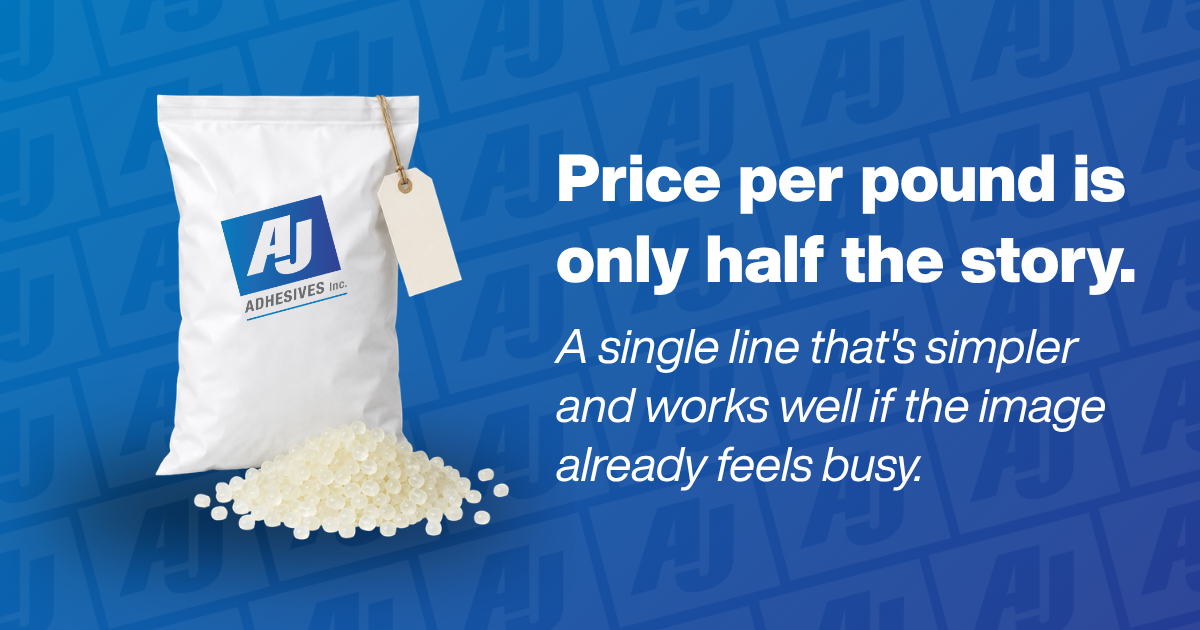
Price per pound is only half the story, though. The other half is how much adhesive goes on each case. In one example reported by Graco, a company that began tracking its hot melt usage found it was using 70% more adhesive than it needed. When nobody measures usage, that kind of waste hides inside the purchase order.
So, start by putting a number on every case. Once you know your cost per case, you can see the effect of every setting change, product change, and price change.
The Adhesive Cost Per Case Formula
The formula has two inputs:
Cost per case = adhesive weight per case (lb) × price per pound
Most scales report adhesive weight in grams. One pound equals exactly 453.59237 grams, according to NIST Handbook 44. So, divide grams by 453.59 to get pounds before you multiply by your price.
| Input | Where to find it |
|---|---|
| Adhesive weight per case | A weigh test on your line (steps below) |
| Price per pound | Your invoice or current quote |
| Cases per year | Your production plan or enterprise resource planning (ERP) system |
| Adhesive type and settings | Your TDS and your line setup sheet |
Multiply cost per case by cases per year, and you get the yearly adhesive spend for that line.
How to Measure Adhesive Add-On Weight Per Case
Add-on weight is the amount of adhesive that ends up on the case. You can measure it with a scale that reads to at least a tenth of a gram. A case seal uses only a few grams, so a coarse shipping scale won't pick it up.
- Pull 10 blank cases of the same size from the same board lot.
- Weigh each blank case and write down each weight.
- Run the cases through the glue station at normal line speed and settings, then pull them right after sealing.
- Weigh each case again. The difference is the adhesive add-on weight.
- Average the 10 results and record the line, shift, adhesive, temperature, and pattern settings next to the number.
Repeat the test after any changeover, setting change, or new lot of board or adhesive. A single test is a snapshot. A log of tests shows you a trend.
How to Measure Water-Based Adhesive Add-On
Weigh cases sealed with water-based adhesive right after application, while the adhesive is still wet. You buy water-based adhesive by the wet pound, with the water included. If you let the bead dry first, the water leaves and the test undercounts your real usage.
How to Check Applied Weight Against Actual Usage
A weigh test shows what lands on the case. It does not show adhesive lost to purging, startups, or char. So, also track the total pounds loaded into the melter over a week, and divide by the number of good cases shipped. If that number is well above your weigh-test number, the gap is waste.
Example: Calculating Adhesive Cost Per Case (Hypothetical Numbers)
The numbers below are hypothetical. They only show how the math works, so use your own weigh-test results and pricing.
| Line item | Adhesive A | Adhesive B |
|---|---|---|
| Price per pound | $2.40 | $2.90 |
| Add-on weight per case | 1.6 g | 1.2 g |
| Add-on weight in pounds | 0.00353 lb | 0.00265 lb |
| Cost per case | $0.0085 | $0.0077 |
| Cost per 1,000 cases | $8.47 | $7.67 |
| Cost for 2 million cases | $16,932 | $15,344 |
In this example, Adhesive B costs more per pound but less per case, because each case needs less of it. Across 2 million cases, the gap is about $1,587.
Compare Adhesives by Cost Per Case, Not Price Per Pound
Two hot melts can have the same price per pound and very different costs per case. The difference often comes from mileage, meaning how many cases a pound of adhesive can seal. Lower density and stronger bonds at smaller beads can both improve mileage.
Some manufacturers publish mileage claims for their products. H.B. Fuller says its Advantra Earthic 9500 closes the same number of cases with at least 25% less adhesive. Henkel says the low-density formula of Technomelt Supra 079 Eco Cool delivers up to 30% less material usage. Treat these as manufacturer figures, and confirm them on your own line.
So, when you compare products, line up each TDS, run a trial, and repeat the weigh test. AJ Adhesives can compare adhesive TDS sheets side by side for you. After any bead size reduction, run bond quality checks like a fiber tear test before you lock in the new setting.
Where Adhesive Waste Hides in Your Cost Per Case
Waste shows up in one of two places. It either raises your weigh-test number, or it widens the gap between your weigh test and your actual usage. The table below shows where each common source appears.
| Waste source | Where it shows up | First check |
|---|---|---|
| Beads bigger than needed | High weigh-test number | Find the smallest bead that still gives fiber tear |
| Char from high temperatures or long idle times | Gap between usage and weigh test, plus clogs | Confirm setpoints against the TDS and use tank setback when idle |
| Purge waste at startups and changeovers | Gap between usage and weigh test | Track how much is purged at each changeover |
| Bond failures and rework | Adhesive spent on cases that never ship | Log rejects by cause on each shift |
| Rush freight on emergency orders | Higher landed cost per pound | Set reorder points with your rep |
Char matters for cost because it starts a chain of waste. H.B. Fuller's maintenance guide says char comes from heat, oxygen, contaminants, and time. It advises against letting glue sit and cook when the line is idle. Bostik notes that a tank set too hot can overheat the adhesive and form char, and that adhesive should ideally turn over at least once a day. So, coordinate any temperature or pattern change with your maintenance team, and record the result.
For step-by-step fixes, see our guide on how to reduce adhesive use without sacrificing line efficiency.
Where AJ Adhesives Helps
Your local AJ Adhesives rep can run a weigh test with your team, compare TDS sheets, and set up an on-line production trial with adhesive products from H.B. Fuller, Henkel, Bostik, and AJ Adhesives Private Label. When equipment is part of the cost, AJ Adhesives' sister company for equipment, Mid-America Packaging (MAP), supports hot melt systems, including rebuild and refurbish services.
Frequently Asked Questions About Adhesive Cost Per Case
How do you calculate adhesive cost per case?
Multiply the adhesive weight on one case, in pounds, by your price per pound. Get that weight by weighing cases before and after the adhesive goes on. Your adhesive distributor can help you run the test.
How many grams of hot melt does it take to seal a case?
It depends on the case size, bead pattern, board, and adhesive. The only reliable number is one you measure on your own line. Check your TDS and ask your adhesive distributor for a starting point.
Is a cheaper adhesive per pound always cheaper per case?
No. An adhesive with a higher price per pound can cost less per case if each case needs less of it. Confirm with a line trial and your TDS before you change products.
How often should you check adhesive add-on weight?
Check it after any changeover, setting change, or new lot of board or adhesive. A regular check on each shift helps you spot drift early. Your adhesive distributor can help you set a schedule.
Talk to Your AJ Adhesives Rep About Adhesive Cost Per Case
Want to know what your adhesive really costs per case? Talk to your local AJ Adhesives rep about a usage review, a sample, or an on-line production trial. We'll help you measure your cost per case, compare options across our supplier brands, and find where waste hides on your line. Our goal is to be the easiest vendor you'll work with.

Click here to contact your AJ Adhesives representative!
Call: (314) 652-4583 | Email: info@ajadhesives.com
Follow us on LinkedIn for more tips, resources, and updates!
Sources
- Producer Price Index by Industry: Adhesive Manufacturing (PCU325520325520), U.S. Bureau of Labor Statistics via FRED (updated Nov. 13, 2026)
- Table Data: Producer Price Index by Industry: Adhesive Manufacturing, U.S. Bureau of Labor Statistics via FRED
- Precisely Monitor Your Hot Melt Adhesive Dispense, Graco
- NIST Handbook 44, Appendix C: General Tables of Units of Measurement, National Institute of Standards and Technology (2026)
- Advantra Earthic 9500: Do More with Less, H.B. Fuller
- Bio-Based Hot Melt Adhesive Helps to Reduce CO2 Emissions in the Packaging Process, Henkel Adhesives
- Hot Melt Preventative Maintenance Guide, H.B. Fuller (2020)
- How To Avoid Equipment Failure from Hot Melt Charring, Bostik (Nov. 13, 2019)
Talk with an AJ Adhesives representative today!
We have AJ Adhesives representatives across the country who can help you compare adhesive options, review spec sheets, and set up on-line trials.